Can the Weather Give You a Headache? What the Research Says
The short answer: they're linked
After my post on weather and joint pain, I asked myself next: can the weather give you a headache? So we went looking. The research says they're linked, and more clearly than for joint pain. A review of 31 studies found that temperature and air pressure were both linked to migraine attacks (Li 2025).
If you get headaches or migraines when a front moves in, here's what the research shows and what you can do about it.
Dr. Sparks' take: this time, the visits moved too. With joint pain, rain didn't change doctor visits. In 11.7 million visits by older Americans, rainy days didn't bring a bigger share of joint or back pain visits (Jena 2017). Headaches are different. At one emergency room, warmer weather in the day before brought in more people with headaches (Mukamal 2009). For some people, a weather headache gets bad enough to need help.
Our Understanding Pain handout explains why pain can change from one day to the next.
What the studies found
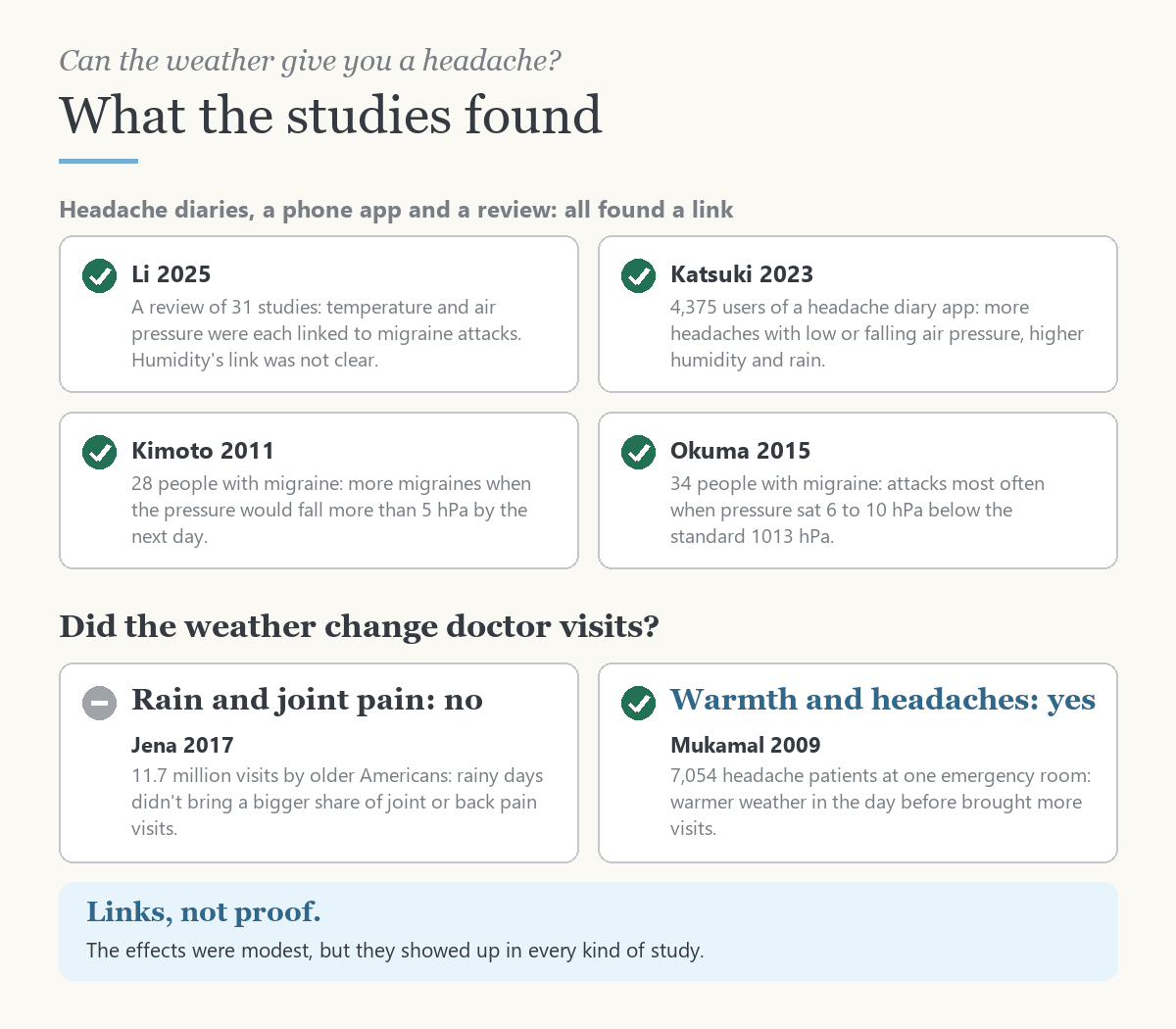
All five headache studies found a link. Air pressure came up in every one, usually as low or falling pressure. Temperature mattered in the review and the emergency room study.
| Study | Who | What was measured | What they found |
|---|---|---|---|
| Li 2025 | A review of 31 studies | Migraine attacks and clinic visits | Temperature and air pressure were each linked to migraine attacks. Humidity's link was not clear. Air pollution went with more migraine clinic visits. |
| Katsuki 2023 | 4,375 users of a headache diary app, one year | 336,951 hourly headache entries | More headaches with low air pressure, a pressure drop in the 6 hours before, higher humidity and rain. |
| Mukamal 2009 | 7,054 headache patients at one emergency room | Weather in the 3 days before each visit | Warmer weather in the day before raised the odds of a visit, about 7.5% per 9 °F (5 °C). Lower pressure 2 to 3 days before raised the odds for headaches that weren't migraine. |
| Kimoto 2011 | 28 people with migraine in Japan, one-year diaries | Headache days and air pressure | Migraines came more often when pressure would fall more than 5 hPa (about 0.15 inches) by the next day. |
| Okuma 2015 | 34 people with migraine in Japan, diaries | Air pressure at each attack | Attacks came most often when pressure sat 6 to 10 hPa (about 0.2 to 0.3 inches) below the standard 1013 hPa, as a low moved in. |
These links were modest, and they don't prove the weather causes headaches. But they showed up in headache diaries, in a phone app, in an emergency room and in a review of 31 studies.
When a headache is an emergency
A headache that hits its worst within an hour is different. In 2,131 adult emergency patients with that kind of headache, about 1 in 16 had bleeding around the brain. Call 911 or go to the ER for a sudden, severe headache, especially if you're 40 or older, have neck pain or stiffness, fainted, or it started during exertion (Perry 2013).
What to do when the forecast changes
You can't change the weather, but you can plan for it.
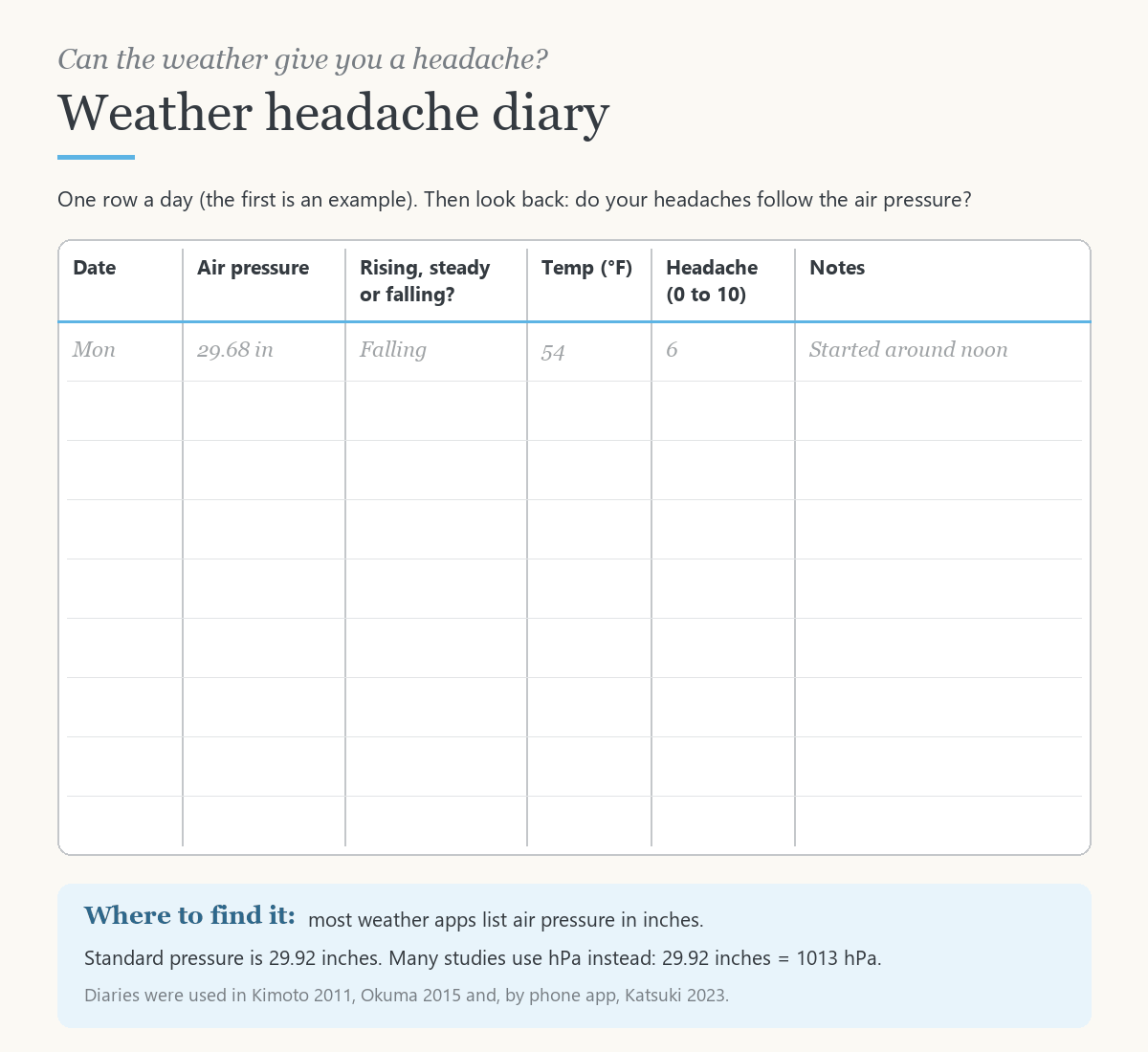
- Keep a headache diary. Write down the date, the air pressure and your headache, using the chart below. Three of the studies used headache diaries (Kimoto 2011; Okuma 2015; Katsuki 2023, by phone app). In one, the weather was linked to migraines in 18 of 28 people, so not everyone is weather-sensitive.
- Read the pressure, not just the rain. Most weather apps show air pressure in inches. In one small study of 34 people, migraines came most often around 29.6 to 29.7 inches, a little below the standard 29.92 (Okuma 2015). Your own diary will show your pattern.
- Plan ahead. If your diary shows a pattern, let a falling-pressure forecast be your cue to follow your own care plan and your doctor's advice.
- Look past the weather. At a visit we also check your neck and jaw, and go over posture, sleep and breathing. For tight muscles at the base of the skull, try our foam rolling guide.
- Ask us. If your headaches follow the weather, tell us. Read why we say give chiropractic a chance for headaches, and see our dry needling, rehabilitation programs, how we approach care and the conditions we treat.
Questions people ask
Why would a pressure drop be linked to headaches? No one knows yet. Our joint pain post, linked above, explains one lead, from animal studies of pain: the inner ear.
Is it the temperature or the pressure? Both showed up. In the ER study, warmer weather mattered most. Lower pressure mattered less, and it showed up for headaches that weren't migraine (Mukamal 2009). The review of 31 studies linked both to migraine attacks (Li 2025).
Does humidity matter? The studies disagree. In the phone app study, higher humidity went with more headaches (Katsuki 2023). The review found no clear link between humidity and migraine (Li 2025).
Does air pollution play a part? Maybe. In the review, more air pollution went with more migraine clinic visits (Li 2025). The ER study found no clear link (Mukamal 2009).
Book a visit
If your headaches keep following the forecast, let's look at why. Book at East Wichita or book at West Wichita. Meet Dr. Keith Sparks, Dr. Rachel Sparks and Dr. Sam Reals, or learn more about our East Wichita clinic and our West Wichita clinic.
Sources
- Li S et al. Association between weather conditions and migraine: a systematic review and meta-analysis. J Neurol. 2025. PubMed
- Jena AB et al. Association between rainfall and diagnoses of joint or back pain: retrospective claims analysis. BMJ. 2017. PubMed
- Mukamal KJ et al. Weather and air pollution as triggers of severe headaches. Neurology. 2009. PubMed
- Katsuki M et al. Investigating the effects of weather on headache occurrence using a smartphone application and artificial intelligence: a retrospective observational cross-sectional study. Headache. 2023. PubMed
- Kimoto K et al. Influence of barometric pressure in patients with migraine headache. Intern Med. 2011. PubMed
- Okuma H et al. Examination of fluctuations in atmospheric pressure related to migraine. SpringerPlus. 2015. PubMed
- Perry JJ et al. Clinical decision rules to rule out subarachnoid hemorrhage for acute headache. JAMA. 2013. PubMed
This article is general information, not advice about your own health.