Can the Weather Make You Hurt? What the Research Says
The short answer: partly true
If your knee or back seems to know a storm is coming before the forecast does, you're in good company. In a study of older adults with osteoarthritis in six European countries, two out of three said the weather affects their pain (Timmermans 2014).
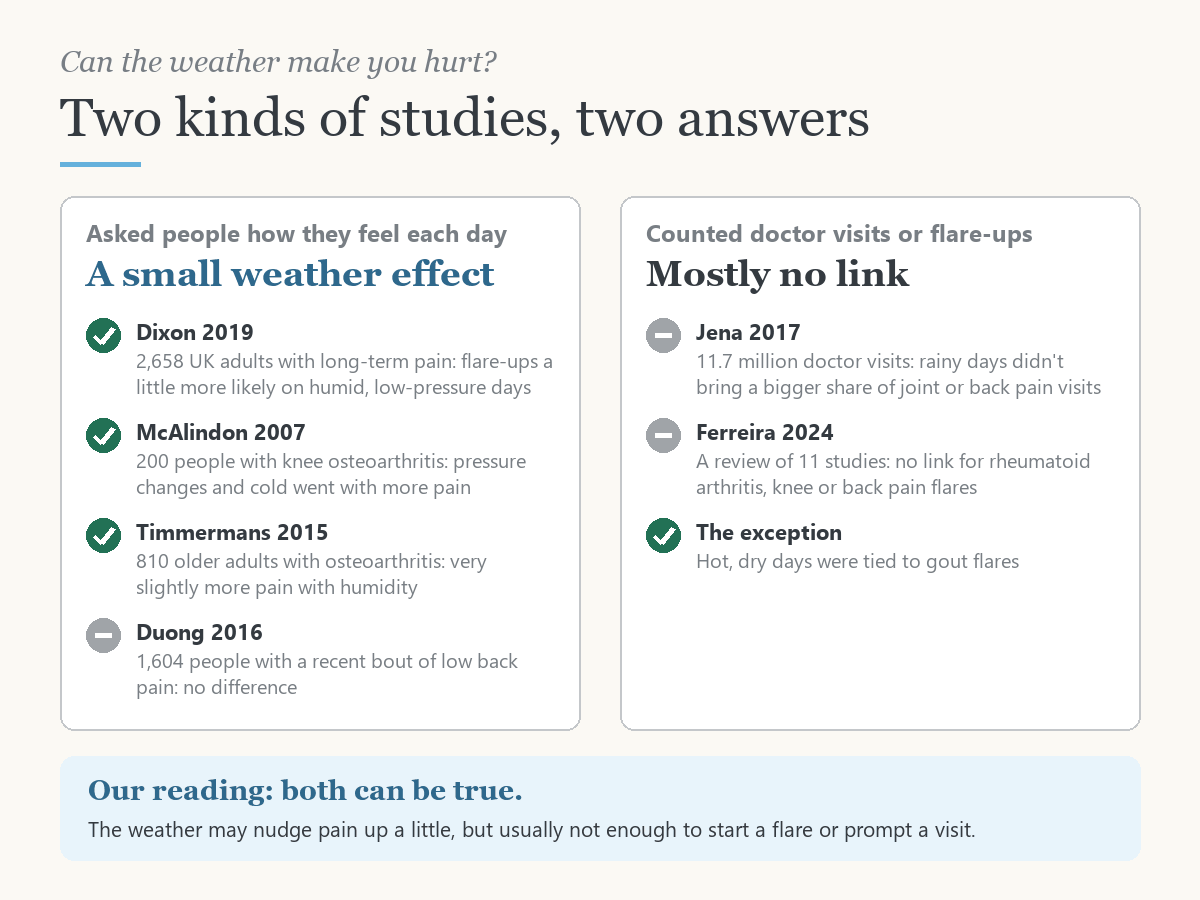
The research gives two answers that look like they disagree. Studies that ask people to rate their pain every day find a small weather effect. Other studies looked at whether the weather changed how often people saw a doctor or had a flare-up, and found little or no difference. If your knee pain or back pain follows the forecast, here's what the research shows.
Why both answers can be right
Dr. Sparks' take: both can be true. The weather can turn the pain dial up a little, but usually not far enough to start a flare or make someone book a doctor's visit. So the studies that count visits miss it, and the studies that ask people how they feel catch it. I also believe pressure or weather changes have become "common knowledge" to the degree people believe there is nothing to do except ride it out.
Our Understanding Pain handout explains why pain can change from one day to the next.
What the studies found
Three of the four studies that tracked people's own pain found a small weather effect, all in long-term pain or osteoarthritis. The fourth, in a recent bout of low back pain, found none. The two that counted visits or flare-ups found no link, except for gout.
| Study | Who | What was measured | What they found |
|---|---|---|---|
| Dixon 2019 | 2,658 UK adults with long-term pain, 15 months, via a smartphone app | Daily pain ratings | Pain flare-ups (sudden jumps in pain) were a little more likely on humid, low-pressure days. Temperature and rain showed no clear link. |
| McAlindon 2007 | 200 people with knee osteoarthritis, 3 months | Pain scores | Changes in air pressure and colder temperatures each went with more knee pain. |
| Timmermans 2015 | 810 older adults with osteoarthritis in Europe | Two-week pain diaries | Pain rose very slightly with humidity, more on cold days. Day-to-day weather changes made no difference. |
| Jena 2017 | 11.7 million doctor visits by Americans 65 and older | Share of visits for joint or back pain | Rainy days didn't bring a bigger share of joint or back pain visits. The authors note a link may still exist. |
| Duong 2016 | 1,604 people with a recent bout of low back pain | Daily pain for 2 weeks | Rain, temperature, humidity and air pressure made no difference. |
| Ferreira 2024 | A review of 11 studies | New pain episodes or flares | No link for rheumatoid arthritis, knee pain or low back pain. The exception: hot, dry days were tied to gout flares. |
Every effect found was small.
How would your body know the pressure dropped?
The best lead so far is the inner ear, and it comes from animal studies.
- In rats with injured nerves, a fast, storm-sized drop in air pressure (27 hPa in 8 minutes) made pain behavior worse. The effect disappeared when the balance cells of the inner ear were damaged, while a drop in temperature still made it worse (Funakubo 2010).
- In mice, a drop in air pressure switched on nerve cells in the inner ear's balance system (Sato 2019; Sato 2025). These studies measured nerve activity, not pain.
None of this has been shown in people yet.
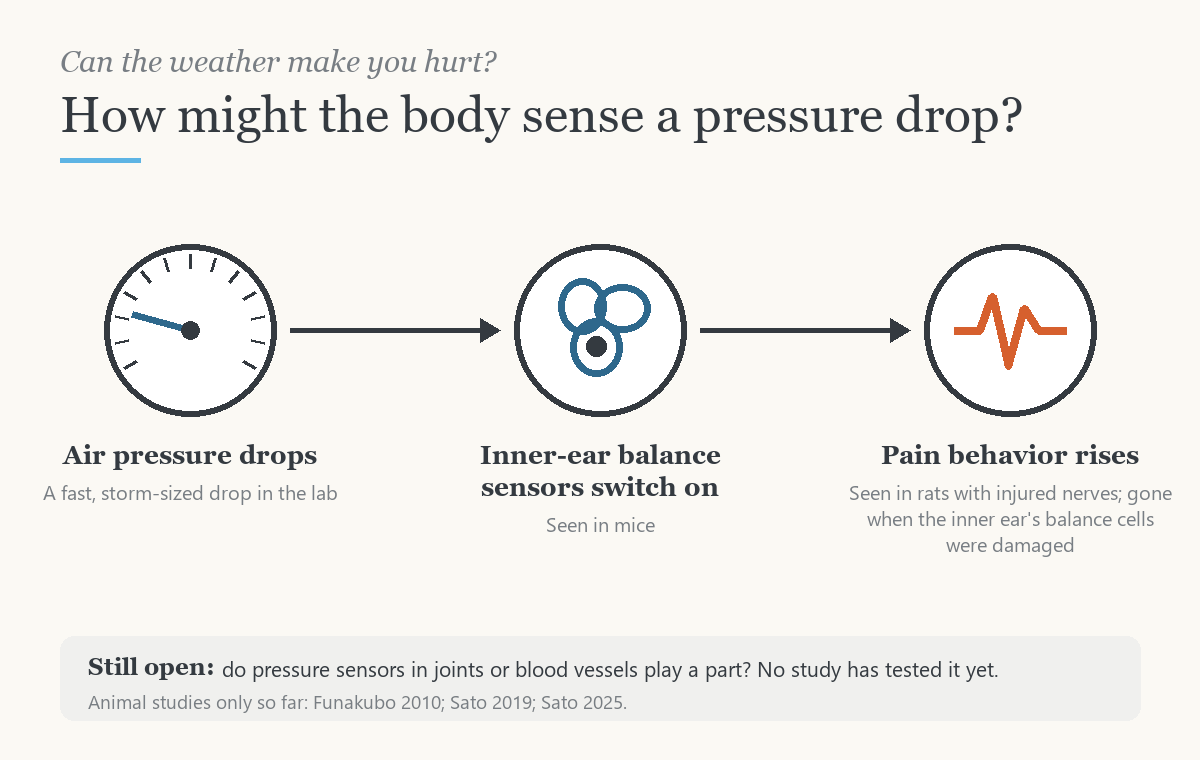
Dr. Sparks' question: could pressure sensors in and around the joints, or in blood vessels, be part of it? So far we haven't found a study that tests this. Basic physics suggests the blood-pressure sensors in your arteries barely notice a weather change, since it presses on the body inside and out. We've sent it to our research team.
What to do on gray days
You don't have to just ride it out. Don't let a forecast keep you on the couch.
- Keep moving. If cold, damp days bother you, dress warm and take your walk indoors: a mall, a gym track or a few laps around the house. Our home mobility routine works in a living room.
- Use the traffic light. Not sure whether to push through a sore day? Our pain traffic light handout and when to stop an activity guide walk you through it.
- Watch for what isn't weather. Pain that's new, keeps getting worse, or comes with swelling deserves a look, whatever the forecast says.
- Ask us. If your pain seems to follow the weather, tell us at your next visit. We'll look at what's going on and explain it in plain words. See how we approach care and the conditions we treat.
Questions people ask
Does cold weather make arthritis pain worse?
A little, for some people. In 200 people with knee osteoarthritis, colder temperatures went with slightly more pain (McAlindon 2007). In a European study, the small effect of humidity on joint pain was stronger on cold days (Timmermans 2015).
Is weather pain all in my head?
The daily-pain studies suggest it's real, just small. In a 15-month UK study of 2,658 people with long-term pain, pain flare-ups were slightly more likely on humid, low-pressure days (Dixon 2019). In the European study, people who called themselves weather-sensitive also reported more pain overall (Timmermans 2014).
Would moving somewhere warmer help?
We didn't find a study that tested it. In the large smartphone study, temperature and rain showed no clear link to pain, while humidity and low air pressure did (Dixon 2019). A knee osteoarthritis study did link colder days to more pain (McAlindon 2007), so the studies disagree on temperature.
Book a visit
If gray days keep slowing you down, let's look at why. Book at East Wichita or book at West Wichita. Learn more about our East Wichita clinic, our West Wichita clinic, Dr. Keith Sparks and our rehabilitation programs. Curious about other pain myths? Read Myths of Foam Rolling and our guide to muscle trigger points.
Sources
- Timmermans EJ et al. Self-perceived weather sensitivity and joint pain in older people with osteoarthritis in six European countries. BMC Musculoskelet Disord. 2014. PubMed
- Dixon WG et al. How the weather affects the pain of citizen scientists using a smartphone app. npj Digit Med. 2019. PubMed
- McAlindon T et al. Changes in barometric pressure and ambient temperature influence osteoarthritis pain. Am J Med. 2007. PubMed
- Timmermans EJ et al. The influence of weather conditions on joint pain in older people with osteoarthritis. J Rheumatol. 2015. PubMed
- Jena AB et al. Association between rainfall and diagnoses of joint or back pain: retrospective claims analysis. BMJ. 2017. PubMed
- Duong V et al. Does weather affect daily pain intensity levels in patients with acute low back pain? Rheumatol Int. 2016. PubMed
- Ferreira ML et al. Come rain or shine: is weather a risk factor for musculoskeletal pain? A systematic review with meta-analysis of case-crossover studies. Semin Arthritis Rheum. 2024. PubMed
- Funakubo M et al. The inner ear is involved in the aggravation of nociceptive behavior induced by lowering barometric pressure of nerve injured rats. Eur J Pain. 2010. PubMed
- Sato J et al. Lowering barometric pressure induces neuronal activation in the superior vestibular nucleus in mice. PLoS One. 2019. PubMed
- Sato J et al. The inner ear is a barometric pressure sensor. Sci Rep. 2025. PubMed
Research read 2026-10-29 and checked by independent readers.
This article is general information, not advice about your own health.